January 19, 2026
My fellow Americans,
On this Martin Luther King, Jr. Day, I write with a reverence for Dr. King’s courage and with a disciplined disappointment that this nation still struggles to practice what it loves to proclaim. We speak the language of liberty while rationing its benefits. We recite founding promises while continuing to treat entire communities as collateral damage. And we call ourselves great while our most vulnerable citizens are asked-again and again-to survive conditions that a truly just society would not tolerate.
Dr. King warned us that the greatest obstacle to justice was not only overt hatred, but the polished indifference of those who prefer “order” over moral repair. Today, we see that indifference in the widening gap between what we say we value and what we fund, protect, and prioritize.
A country cannot celebrate freedom while managing poverty
We cannot honor Dr. King with holiday speeches and parades while ignoring that the “freedom” many people experience is merely the freedom to struggle; freedom to ration groceries; freedom to choose between medication and rent; freedom to work full-time and still drown.
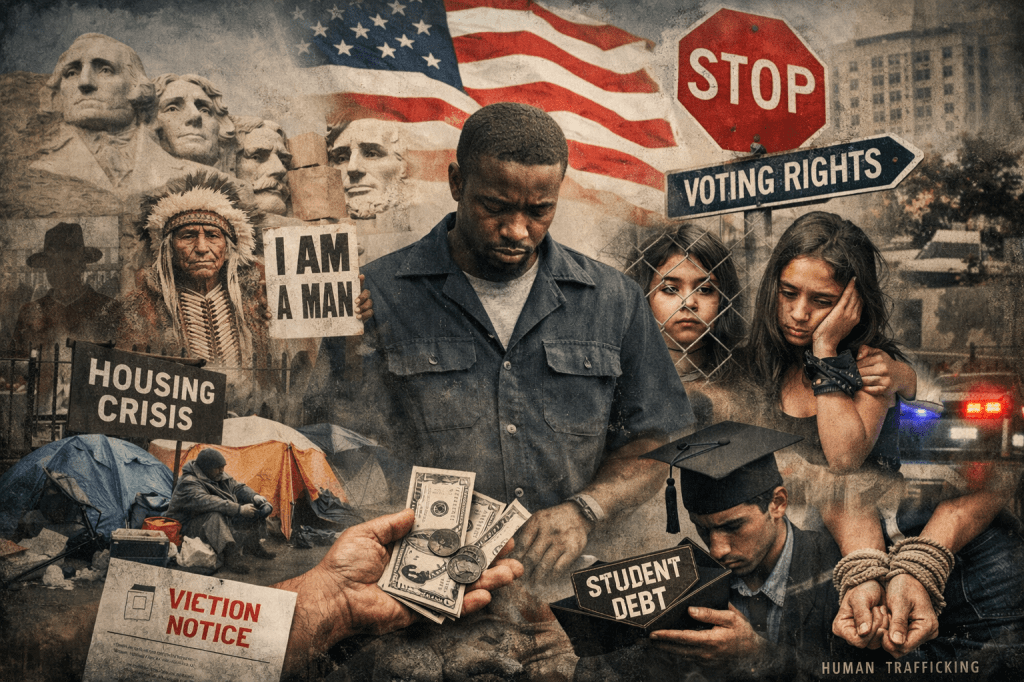
We are watching housing become a threat to stability rather than a foundation for it. The U.S. recorded more than 770,000 people experiencing homelessness on a single night in January 2024! That was the highest point-in-time number recorded. That is not a statistic; it is an indictment. It is children sleeping in cars. It is elders choosing between shelter and safety. It is workers who keep cities running but cannot afford to live in them.
Meanwhile, we debate educational access as if it were a luxury instead of a national survival strategy. When students lose pathways to afford school, when aid is narrowed, delayed, or treated as politically disposable, we do not “save money.” We simply transfer the cost to families who already cannot bear it, and to communities that will later pay the price in instability, underemployment, and despair.
Dr. King was explicit: Justice requires financial roadmapping-not symbolic inclusion. It requires policies that actually lift. It requires wages that match the cost of living, housing that is attainable, and education that is not a debt sentence. A nation cannot call itself exceptional while normalizing conditions that crush human potential by zip code.
A nation cannot invoke democracy while weakening the people’s voice
We are also living through a dangerous civic contradiction: the steady erosion of trust, truth, and fair participation, paired with a loud insistence that everything is fine. But democratic health is not measured by slogans-it is measured by access, accountability, and equal protection!
When voting rights are narrowed, when districts are engineered to dilute community power, when citizens are treated like problems to manage rather than voices to honor, we don’t simply “disagree.” We destabilize the moral architecture of the republic.
And we should say plainly what Dr. King would not tiptoe around: Our nation has repeatedly rewritten who counts as fully human, and who does not.
We cannot speak of “law and order” without naming the original disorder
Before there was a “Negro,” before there was a “Colored,” there were nations on this land with names, languages, governance, spirituality, and sovereignty. And the record of this country includes forced removal, broken treaties, boarding schools, land theft, and cultural erasure. “America” was built on a profound displacement, and our refusal to fully tell that truth continues to shape whose suffering is considered normal.
Then came the brutal invention of racial categories to justify a racial economy-one that extracted labor and denied personhood. Even as words shifted-Negro to Colored to Black to African American-the nation’s habits often remained: free labor and/or underpaid labor and indentured servitude, underfunded schools, over-policed and redlined neighborhoods, predatory lending, and unequal access to the very “opportunities” we claim are universal.
And now, in our present day, we are experiencing more of the same. Meanwhile, we watch immigrants, many of whom feed our cities, care for our elders, build our homes, power our economies, and share in the ancestries of the indigenous to this very land-treated as disposable, scapegoated for dysfunction they did not create. We praise “hard work” as an American virtue, then sideline, cage, deport, and worst of all, unalive the very laborers whose hard work sustains our comfort, and/or seek a better life for themselves and their families.
This is not simply inconsistent. It is immoral. It is dehumanizing. It is a crime against humanity!
The crisis we don’t talk about enough: Exploitation in plain sight
There is another injustice-quiet, pervasive, and too often buried beneath the noise of daily headlines: trafficking and exploitation.
Human trafficking does not always look like a movie scene. It can look like control, coercion, debt, threats, isolation, and fear. It can look like a teenager who suddenly has an “older boyfriend.” It can look like a worker who can’t speak for themselves because someone else “handles everything.” It can look like a person who seems watched, rushed, or unable to make eye contact.
And it is happening here.
The Bureau of Justice Statistics reports thousands of suspected human trafficking incidents and victimizations identified by law enforcement each year, while also emphasizing the challenges in measurement and the likelihood of undercounting. In other words: What we know is serious and what we don’t know is likely worse.
If we can obsess over stock prices and political theater, we can also train ourselves to notice distress, coercion, and danger in everyday life.
What do we do with this truth?
This is not a letter of despair. It is a letter of demand—because hope without action is sentiment, not faith.
Dr. King did not ask America to feel guilty. He asked America to grow up.
So here is the call:
Stay vigilant in public spaces. If something feels off, don’t “mind your business” in the event of someone else’s tragedy. Pay attention to patterns: who speaks, who is silent, who seems controlled, who looks afraid.
If you see someone in visible distress, act responsibly. You do not have to intervene physically to intervene morally. You can make a report. You can request a wellness check. You can share information with authorities or a trusted hotline. You can do it anonymously. You can save a life with a license plate number, a location, a time, and a description.
Remember details. Clothing, tattoos, vehicle make/model, direction of travel, who appeared to be in control, what was said, where you were. In crises, details are mercy.
Build a community culture that protects people. Teach children bodily autonomy and safe adults. Support survivor-centered organizations. Push schools, workplaces, and faith communities to have protocols-not just thoughts and prayers.
Demand policies that match the country we claim to be. Housing that people can afford. Education that people can access. Wages that people can live on. A democracy that people can trust. Safety that does not depend on privilege.
A final word because we are not finished…
Dr. King believed in the capacity of ordinary people to do extraordinary good. But he also warned us plainly that time is not neutral. It can be used as a tool for progress, or it can be used as an excuse to postpone justice indefinitely. In Letter from Birmingham Jail, he rejected the soothing myth that we can simply “wait” our way into a better nation. Waiting, he made clear, is often the language of those who are not the ones bleeding.
So let us be honest with ourselves on this day: America is not redeemed by its ideals. America is redeemed by its obedience to them.
That means we must stop confusing ceremony for commitment. We must stop grading the nation on intention and start grading it on outcomes. We must stop treating the suffering of poor families, displaced communities, immigrants, and exploited children as “unfortunate realities” instead of policy decisions and moral failures. If our democracy is strong, it should be able to hold its own reflection. If our faith in freedom is real, it should be visible in who gets to live safely, learn fully, and belong without fear.
And yes! This requires courage. The courage to challenge tyrannical policies. The courage to resist the comfort of silence. The courage to intervene responsibly when you see someone in danger. The courage to protect the vulnerable not only when it is popular, but when it is inconvenient.
Because a country is not great because it is loud. Not because it can flex military might or dominate headlines. A country is great when its most vulnerable are protected; it is when the child can study without hunger, when the elder can retire without panic, when the newcomer is not dehumanized, when the exploited are seen, believed, and rescued, and when the poor are not treated as disposable.
Aren’t we all in search of a better life? Wasn’t it a pursuit of happiness that fueled the ships and hearts of the Europeans to our shores-isn’t it the same spirit that continues to push modern immigrants here today?
And if you’ve ever had the opportunity to visit Liberty Island, you may remember that our national symbol carries not a weapon, but a lamp; and beneath it, Emma Lazarus’s enduring demand:
Give me your tired, your poor,
Your huddled masses yearning to breathe free,
The wretched refuse of your teeming shore.
Send these, the homeless, tempest-tost to me,
I lift my lamp beside the golden door!
That is not just poetry. It is a moral standard, one we have drifted from, and one we must return to with discipline and resolve.
So on this Martin Luther King, Jr. Day, I ask us to choose integrity over indifference. To choose vigilance over denial. To choose action over applause. To recognize that we are bound together; what harms the most vulnerable ultimately harms the nation’s soul.
And to remember this: The arc does not bend on its own. It bends when we put our hands on it—together. If freedom and justice are not yet fully true for all, then our work has not ended.
It has only begun.
Want to continue the conversation? Please leave a comment below and share this article.

 The Write Movement Presents:
Leave a comment